Ship launch failures happen when a vessel — during the transition from land or slipway to water — suffers a structural collapse, capsizes on entry, grounds mid-slide, or is released into conditions it can't survive. The causes divide roughly into three categories: mechanical (failed drag chains, seized launching cradles, miscalculated ballast), environmental (tidal miscalculation, unexpected crosswinds, hull-bottom obstruction), and human (skipped pre-launch inspections, crowd interference, command errors under time pressure). None of these is a freak event. Every one recurs across documented launches with enough regularity that the patterns are recognizable before the fact, not merely explainable after it.
What's striking, looking at the record, is how often the same mistakes appear decades apart — different ships, different shipyards, same failure mode. A drag chain not properly calibrated for hull weight; a side launch angle that ignores tidal height; a pre-launch walkthrough abandoned because the schedule slipped and nobody wanted to be the one to push back. The catastrophic and the embarrassing share roots. Pressure compresses checklists, assumptions substitute for measurements, and the whole operation quietly inherits a cultural belief that the hard part was building the ship rather than putting it in the water — a belief that can reduce a multi-year construction project to wreckage in under thirty seconds.
That belief is where most of the damage begins.
What actually causes a ship launch to go wrong
Ship launches fail because of four overlapping categories of error: structural miscalculation, mechanical failure on the slipway, wrong environmental timing, and human positioning mistakes. Most disasters involve at least two of these at once — one failure creates the condition for a second.
Weight and balance problems are the most structurally damaging. A hull that is heavier on one end than the shipyard's calculations assumed will rotate unpredictably the moment it loses full contact with the slipway. The SS Daphne, launched on the Clyde in 1883, capsized within seconds because workers had boarded her before launch — extra mass in the wrong place, high up, on a hull not yet stable in water. 124 people drowned. The root cause was a centre-of-gravity problem compounded by the last-minute decision to have men aboard during the slide. Nobody ran the numbers again after that decision was made.
Grease and slipway mechanics are the second major category, and they're underestimated. The hull is held back by friction until it isn't — and that transition needs to be smooth, controlled, and graduated across the full length of the slide rather than breaking unevenly at one point. If the tallow and soft soap mixture (still used in traditional launches) has degraded in cold weather, sections of the slipway may grip unevenly. One section grips. The hull hesitates, builds tension, then releases in a lurch. That sudden acceleration can crack keel supports, twist the hull, or send the ship into the water at an angle that flips it before buoyancy has a chance to do its job.
Tidal timing is a quieter failure mode — no drama on the slipway, just a ship entering water that's either too shallow to float her properly or churned by crosscurrents she can't yet steer against. A vessel launched at low tide on a river with a sharp bend has almost no margin. Ceremony-driven scheduling, where the launch window is set around dignitaries rather than hydrography, has historically been the mechanism by which that margin disappears entirely and the compromise becomes visible only after the hull is already moving.
Then there is the crowd problem, which appears in nearly every catastrophic launch and still gets treated as an afterthought. People congregate on the hull, on temporary platforms, on the dock edge. In some documented cases, the chain-check mechanism — the drag chains meant to slow the hull after it enters the water — has tangled with bystanders or their equipment. That category of failure is not mechanical. It is organizational: the wrong bodies in the wrong positions because nobody enforced a boundary.
These four categories are not independent. They interact, and they accelerate each other.
What are common boat launching mistakes that happen repeatedly
The same four failures appear in post-mortems with enough regularity that calling them "common" understates it — they are practically predictable. Inspections get rushed, crowds drift into hazard zones, stoppers are undersized or mispositioned, and operators apply lessons from the last hull to a ship that behaves nothing like it.
Skipping or compressing pre-launch inspections is the most documented of these. Schedule pressure is the usual explanation, and it is usually accurate. A yard behind on delivery will shave time wherever the loss is least visible, and a checklist that takes four hours gets done in ninety minutes — which means grease application on the slipway goes unverified, hull plug positions are assumed rather than confirmed, and temporary supports are never checked for load distribution under the final pre-launch weight. The failure that follows looks sudden. It was not.
Crowd management — or its absence — is underestimated as a root cause partly because when something goes wrong, attention snaps to the hull rather than to the people who wandered into the run-out zone. Workers drift. Onlookers, invited guests, photographers, and colleagues from adjacent berths all migrate toward the water as excitement builds, and official exclusion zones get compressed by optimism about where the hull will actually stop. The 2016 Hoegh Osaka incident wasn't a launch failure, but the forensic attention paid to load and heel dynamics in that case showed how little margin exists between planned and actual behavior — a lesson that applies directly to launch-day crowd positioning, where the gap between the marked boundary and where people actually stand can be measured in meters.
⚠️ Blocking and stopper failure is more mechanical in its cause but no less human in its origin. Stoppers are sized and placed based on displacement estimates, and those estimates are sometimes calculated for the planned configuration rather than the actual one. A hull launched heavier than documented — carrying water in ballast tanks that were supposed to be empty — will overshoot braking systems that were perfectly adequate on paper.
The fourth pattern is the most stubborn because experience is hard to argue against — and that's the problem. An operator with twenty successful launches becomes, paradoxically, a liability when hull number twenty-one has meaningfully different beam-to-length ratios or a shifted center of gravity. The instinct is to trust what worked before, but a different displacement changes how the hull transfers momentum through the water in ways that past success simply offers no warranty on.

How side launches differ from end-on launches — and why they fail differently
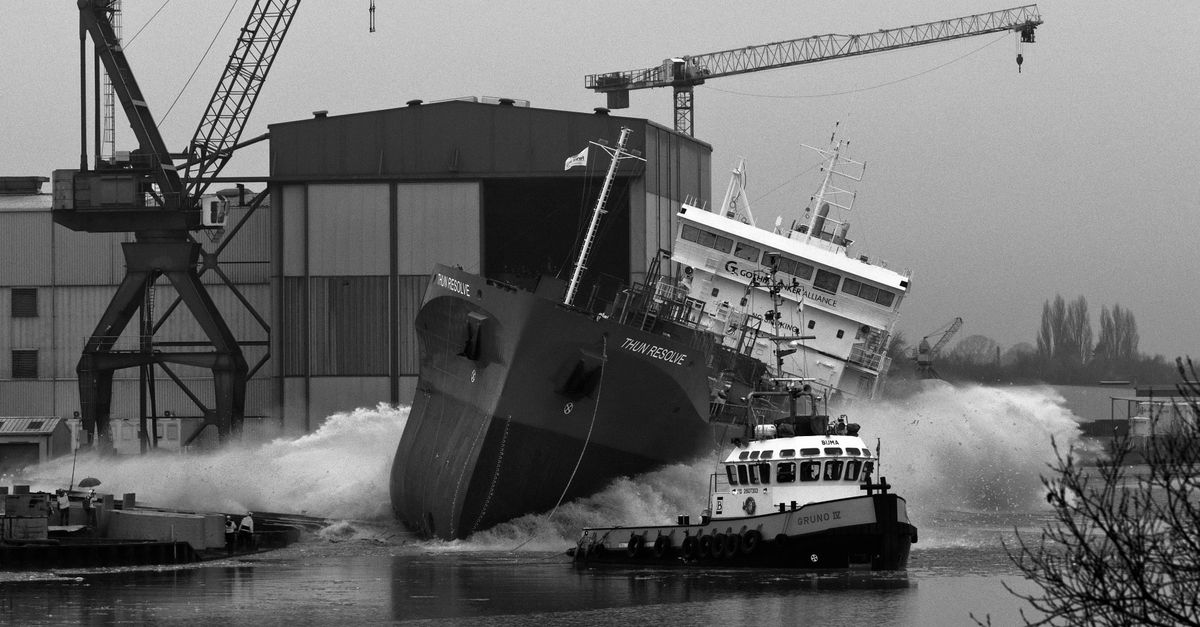
A side launch is a controlled near-capsize: the ship enters the water broadside, rolls sharply toward the river or channel, and must recover before the roll exceeds the hull's righting capacity. Simpler, in one sense, than it looks — but the failure modes are unforgiving. A slipway launch sends the vessel bow- or stern-first down a greased incline, a trajectory with none of that lateral drama, and what makes each method go wrong is as different as the physics driving them.
In a traditional end-on launch, the primary dangers are arrested momentum (the ship stops partway and never fully enters the water) or excessive run-out (it travels too far and strikes the opposite bank or a moored vessel). The vessel stays roughly upright throughout. A side launch, by design, does not. The hull tips past 30 or 40 degrees into the water, relying on hull geometry and internal ballast to generate a restoring moment before the roll exceeds the point of no return. The window between "successful dramatic entry" and "complete capsizing" can be a matter of seconds and a few degrees of arc.
Harbor width is everything. The ship cannot travel far laterally — the opposite bank may be 80 or 100 meters away — so the energy of the launch has to dissipate almost immediately. Engineers calculate the run-out using drag chains, water brakes, or carefully weighted hull sections. Get that calculation wrong and the hull either rolls too far without recovering, or reaches the far bank still carrying enough momentum to cause serious structural damage. That's the precise scenario that produces the viral footage most people associate with Dutch shipyards — not a theoretical edge case but a documented, recurring one.
The Netherlands — specifically the inland yards along rivers like the Ems and the Noord — developed the side launch tradition out of necessity. Narrow waterways left no room for the long run-out a slipway requires. The Dutch inland shipyard became extraordinarily skilled at the technique, refining it across generations of river-constrained builds until the margin calculations were almost institutional knowledge. Watching a 10,000-tonne vessel drop sideways into a channel barely wider than the ship is long, then recover without touching the far bank, is something that stops you mid-scroll — the engineering tolerance is visible in a way most structural feats simply are not.
When a side launch fails, it tends to be visible and total — the hull rolls past recovery and lies on its side in shallow water, or it impacts the far bank in a way that buckles plating. A failed slipway launch looks quieter: the vessel grounds out halfway down the ramp, or drifts into something after entering at low speed. Both are costly. But the side launch failure, when it happens, tends to happen fast and completely, with no intermediate state where intervention was possible.

What ship sank in 3 minutes and why that speed matters
The vessel most often cited in connection with a near-instantaneous sinking is the Vasa, the Swedish warship that capsized in Stockholm harbor in 1628 — not in three minutes, but in under twenty. Speed varies. The ship that sank in roughly three minutes is the MS Estonia ferry, lost in 1994, though that was a storm casualty rather than a structural failure during entry into the water. For the specific "three-minute sinking" framing that circulates online, the closest verified case tied to structural failure during or immediately after entering water is the Kursk submarine's loss sequence, where flooding compartments sealed the outcome within minutes of the initial explosion — a chain of events the surface record gave almost no warning of, and which investigators spent years reconstructing from wreckage that told a very different story than the timeline visible to anyone watching. The pattern across all of them is identical: speed of sinking is determined by what was already wrong with the hull before water entered, not by the flood itself.
Three minutes shocks people. The shock usually lands in the wrong place, though, because a ship that goes under that fast didn't develop a fatal flaw in those three minutes — the flooding is the final act of a process that probably started during construction, during launch-phase stress, or during an earlier transit that nobody documented carefully enough to flag as dangerous. Launch entries apply enormous asymmetric force across a hull, particularly in side launches, which create sudden lateral compression, and the resulting micro-fractures in welds or riveted seams can pass a visual inspection without registering as anything requiring immediate attention.
Hatches and porthole seals compound this. Vasa capsized partly because her lower gunports were open and sat too close to the waterline; water entered through intentional openings, not structural failure. The launch looked fine. The crowds cheered. Then the physics caught up with a design that had been flawed for months before she touched water.
⚠️ The distinction worth holding onto is between a launch failure and a post-launch structural failure. A launch failure is visible: something goes wrong during the entry event itself. A post-launch structural failure is a deferred reckoning — damage absorbed during or before the launch that only manifests once the vessel is under load, underway, or exposed to conditions it was never actually built to withstand.
Why cruise ship launches rarely fail publicly — and what hides the risk
Modern cruise ship launches almost never fail visibly. The slipway slide is extinct. The dominant method today is the controlled float-out: a dry dock is flooded in a managed sequence, the hull rises off its blocks, and the vessel is towed clear — no crowd, no champagne arc through the air, no lurching into open water. What most people picture when they search for cruise ship launch footage is a technique the industry quietly retired decades ago for vessels of this scale.
The engineering validation that precedes a float-out is exhaustive by design. Stability calculations are run weeks in advance, factoring in the hull's weight distribution at the precise moment of lift-off, including any asymmetric loading from partially installed equipment. Keel blocks are inspected individually. Dock gate seals are tested under pressure before any flooding begins. By the time water enters the dock, the vessel has essentially been launched on paper dozens of times.
Which is exactly why the residual risk migrates somewhere less visible — the fitting-out phase. A hull that floats cleanly can still suffer serious incidents while berthed at the outfitting pier: a crane collapse during equipment installation, a flooding event caused by an open hull penetration before internal compartments are sealed, a fire in unfinished electrical runs. Risk moves, it doesn't disappear. The 2020 fire aboard the Mardi Gras during construction at Meyer Turku is a reasonable example — the incident occurred months before delivery, during the final fit-out period, well after the hull had floated without incident, which is precisely the kind of case that never gets filed under "launch failure" in public memory.
Scale is the complicating factor that cuts both ways. A 300-metre hull distributes its mass so evenly that certain instability failure modes become nearly impossible — there is no realistic scenario where a modern cruise ship rolls on the slip the way a smaller vessel might. But scale also means that any structural deficiency, flooding event, or crane incident carries consequences measured in hundreds of millions of dollars and dozens of lives. The probability collapses; the magnitude does not. Rare does not mean safe — it means the failures, when they come, are simply expensive enough to settle quietly.
What product launch failures share with ship launch failures — and what founders miss
Both ship launches and product launches fail for the same structural reason: the system was never tested under the load it would face at the moment it mattered most. A hull that holds in dry dock can split at the waterline the second displacement forces redistribute through poorly seated joints. A distribution channel that works fine for a beta list of 40 people collapses when 4,000 show up at once — broken signup flows, overloaded APIs, payment processors flagging unusual volume. The failure looks sudden. The cause was baked in weeks earlier.
Timing compounds this. Naval engineers pick a launch window around tidal conditions; miss it and you're dragging a ship across a sandbar. Product launches have the equivalent — market saturation windows, competitor announcement cycles, seasonal attention drops. A solo founder who ships into the week of a major platform conference isn't just competing for attention; they're launching at low tide and hoping friction won't matter.
💡 The spectator crowd problem is underappreciated. When the Tillikum slipway launch failed in 2007, part of the chaos came from onlookers who had gathered before containment was in place — crowds on the slipway who became a variable nobody planned for. Public launches before you have a warm, ready audience do something structurally identical: you expose the launch to people who have no context, no stake, and no patience for rough edges. They don't convert; they bounce, and they skew your early metrics in ways that distort every decision that follows. A contained pre-launch group — even 200 people who asked to hear from you — is not a compromise. It's load management.
The fix is boring: a written, channel-mapped plan that functions as a pre-launch inspection checklist. Which channels, in which order, on which day. What the fallback is if a channel underperforms. What "ready" actually means before you flip the switch. This kind of document forces you to find the weak joints before the crowd arrives. If you want a working template to start from, this walkthrough of a structured product launch marketing plan maps out the channel sequencing and timing logic that most solo founders skip entirely.
One honest limitation: a plan like this takes two to three weeks to build properly, and many indie developers don't have that runway. In that case, a constrained soft launch to a small list is almost always better than a compressed public launch — even if it feels like a smaller moment.
FAQ
What are the most common causes of ship launch failures?
Most ship launch failures trace back to three overlapping problems: incorrect sequencing of the launch procedure, environmental conditions that weren't properly accounted for (water depth, current, wind), and mechanical failures in the cradle or slipway system that go undetected until the hull is already moving. Human error — specifically, skipping or rushing a step in a process that has no room for improvisation — accounts for the majority of incidents where things go wrong fast.
What ship sank in 3 minutes after launching?
The MV Sewol is sometimes cited in discussions of rapid sinkings, but the vessel most associated with a catastrophic post-launch loss within minutes is the Vasa, a Swedish warship that capsized and sank in 1628 roughly 1,300 meters into her maiden voyage — though accounts of the timeline vary. More recent incidents involving vessels that foundered within three minutes of launch typically involve smaller craft where a combination of improper ballasting and structural compromise allowed flooding to overwhelm the hull before any corrective action was possible.
How is a cruise ship launched into the water?
Modern cruise ships are almost never launched in the traditional sense. They are built in dry docks that are then flooded in a controlled manner, or assembled in graving docks and floated out once the basin is filled — the vessel lifted by rising water rather than sliding or rolling into it, which eliminates most of the kinetic risk associated with slipway launches. Outfitting follows. Final work happens after the hull is already afloat, which also makes inspections far easier than they would be mid-launch.
What is a side launch and why does it sometimes go wrong?
A side launch puts a ship into water by rolling it sideways off a slipway rather than sliding it bow- or stern-first. The technique generates significant lateral momentum, and the hull must enter the water, stabilize, and absorb that energy without capsizing — all in a matter of seconds. Failures occur when the water is too shallow to allow the hull to right itself after the initial roll, when the vessel's center of gravity is miscalculated, or when the triggers and cradle release unevenly, causing the hull to enter the water at an angle rather than cleanly.
What is the most famous ship that sank after launch?
The Titanic is the most widely recognized ship to sink after its launch and maiden voyage, having struck an iceberg in April 1912 and sunk with the loss of over 1,500 lives — though it launched successfully and the disaster came days into service rather than at the moment of launch itself. In terms of ships that failed structurally or sank close to the launch event, the Swedish warship Vasa holds that distinction: it capsized on its first outing in 1628, the result of a hull that was too narrow for the weight of its upper decks, a flaw that was known to some involved in its construction but never formally acted upon.
What Founders Should Do Before Their Own Launch Goes Public
Ship launch failures are almost never random. Dig into any high-profile case — the Vasa's catastrophic maiden voyage, the cruise ship launches that quietly required last-minute structural corrections, the side-launch videos where a hull rolls past recovery — and the same three failure modes keep surfacing: steps performed out of sequence, timing that ignored environmental conditions, and assumptions about stability that nobody actually verified. Luck might affect the magnitude; it rarely determines whether something goes wrong in the first place.
Product launches fail for structurally identical reasons. A feature ships before the customer support team has documentation. A pricing change goes live before the sales team has been briefed. A campaign drives traffic to a signup flow that hasn't been load-tested — and by the time anyone notices, the window for a clean correction has already closed. Each of those is a sequencing error, the same category of mistake that sends a hull into water at the wrong angle, and the specific domain being different doesn't change the shape of the failure.
The most useful thing a founder or launch lead can do before going public is to map their launch as a sequence, not a checklist. Sequence is everything. A checklist confirms that individual items exist; a sequence asks whether they're in the right order and whether each step has been verified before the next one depends on it — a distinction that matters most under pressure, when the temptation to compress the timeline or skip an "obvious" step is highest, and when the cost of getting it wrong is no longer theoretical. That's exactly when most launches go sideways.
So: before the announcement goes out, before the press embargo lifts, before the Product Hunt post is scheduled — pull up the plan and ask whether it's sequenced and channel-mapped, or whether it's a list of things that all feel roughly simultaneous. Worth a few hours of rework if the answer is the latter. The Vasa's builders knew something was wrong with the weight distribution, had reason to raise it formally, and launched anyway — and most product launch postmortems contain a version of that same sentence, written in the past tense, about something that could have been caught in the week before.